In Country Club Hills, the Grass Ban Stops at the Sidewalk
October 22, 2026
October 22, 2026
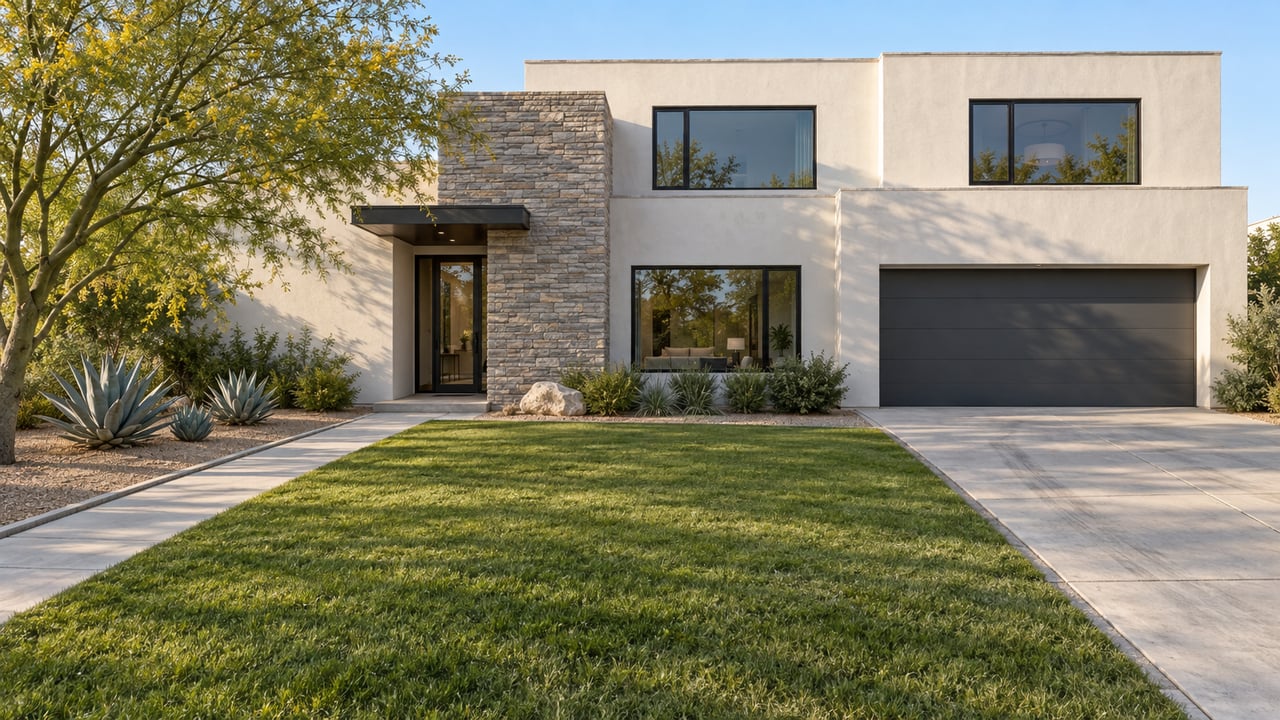
A buyer touring Country Club Hills this fall sees mature trees, clipped lawns and green edges running down to the curb. On January 1, 2027, that greenery comes under two different sets of rules. Under Nevada's AB 356, Colorado River water delivered through the Southern Nevada Water Authority can no longer irrigate nonfunctional turf. The SNWA's own explanation of the law says ordinary front and back yard grass at single-family homes falls outside the ban.
The dividing line between those two sets of rules is the sidewalk. Grass between the sidewalk and the house can stay. The strip between the sidewalk and the curb, along with HOA-maintained common turf, generally cannot be watered with that supply after the deadline. In a community of roughly 170 to 180 semi-custom homes built in the 1990s, much of the "mature greenery" premium sits on the side of that line the homeowner does not control.
The SNWA counts several kinds of grass as nonfunctional. These include streetscape turf along public or private streets, sidewalks, driveways and medians, and HOA-managed turf with no recreational purpose, whatever the zoning. In 2023, AB 220 changed the test from how a parcel is zoned to whether it is used exclusively as a single-family residence. That change matters most for the strip of grass along the curb.
In August 2025, a homeowner asked the Las Vegas Review-Journal about those strips, and the Las Vegas Valley Water District answered directly:
"We have not come across a grass landscape strip as described that is exclusively used as a single-family residence — the grass strips are either common areas or encumbered by an easement that allows others to use it."
Put another way, the curb strip is caught by the ban whether the deed treats it as common area or as private land under an access easement. In the same answer, the District said grass between the sidewalk and the home is exempt and may stay.
| Where the grass sits | Status under AB 356 from Jan. 1, 2027 | Who decides what happens next |
|---|---|---|
| Front and back yard of a single-family home | Outside the ban | The homeowner |
| Strip between curb and sidewalk | Nonfunctional, per LVVWD | The HOA or easement holder, within the law |
| HOA common turf with no recreational purpose | Nonfunctional | The association's board and budget |
| Golf course greens, tees, fairways, rough, practice areas | Functional | The course, within its water budget |
The ban does not reach TPC Summerlin's playing areas. Golf play areas count as functional turf. That protects the green view out back for the homes with direct fairway frontage.
The course is still under a separate limit. The water district says it cut the annual golf water budget in its service area from 6.3 to 4 acre-feet per irrigated acre, effective 2024. TPC Summerlin had already responded. A September 2024 report from Golf Daily said the course removed 12 acres of turf in its second straight reduction project, after eight acres the year before. Most of that work was outside the playing areas, 50 yards or more from the center of the fairways.
Those out-of-play margins are often what a fairway lot looks across. The view from a Country Club Hills patio is already being shaped by a water budget, with or without AB 356.
When a curb strip loses its grass, the trees in it raise a separate question. The Las Vegas Valley Water District's proposed service rules would make spray irrigation in converted former turf areas a non-essential use. Plantings there would move to drip, so the conversion decides how the street's trees get water, not only what covers the ground.
Tree loss is disputed. In January 2026, the Review-Journal reported that plaintiffs in a lawsuit against the water authority allege that conversions tied to AB 356 have killed an estimated 100,000 mature trees and caused $300 million in damage. Those are allegations, not findings. A water authority spokesman later told the Review-Journal that the agency knows the region's tree canopy is shrinking and attributes the decline to extreme heat. The earlier Review-Journal story noted that the agency has also pointed to inadequate watering after conversion.
Either way, how well a converted strip is irrigated and maintained is now the main thing deciding whether a tree-lined street stays tree-lined. That is a management question, and it is answered in an association's budget.
The Summerlin associations have been paying for this in plain view. Summerlin North Community Association's 2025 budget included $400,000 for "Mandatory Turf Conversion" and projected $75,000 in SNWA rebate revenue. The budget narrative tied that money to ongoing work required under AB 356 and SNWA rules. The Summerlin Council's 2025 budget described more than 480 acres of common-area parks and open space and set aside $1.512 million for revegetation, renovation, turf reduction and new open space.
The rebate is a key part of the math. The SNWA currently pays HOAs, businesses and multifamily properties $5 per square foot for the first 10,000 square feet of converted grass and $1.50 per square foot after that. Applicants need a pre-conversion inspection and generally must finish within 12 months. Summerlin West Community Association's January 2026 board summary said its conversion must be finished by year-end 2026 to qualify for the rebate. So an association that waits past the deadline may pay more of the cost itself, and that cost lands in its reserves and assessments.
After the deadline, the fines would also come into play. On September 30, 2026, the Las Vegas Valley Water District began amending its service rules to treat irrigation of nonfunctional turf at commercial, multifamily and HOA common-area properties as water waste, Fox5 reported. The District's published notice proposes these fees:
| Meter size | 1st violation | 3rd violation | 5th or more |
|---|---|---|---|
| 1″ and less | $80 | $320 | $1,280 |
| Over 1″, under 3″ | $160 | $640 | $2,560 |
| 3″ and over | $320 | $1,280 | $5,120 |
The District's board takes up the business impact statement on November 3, holds a public hearing on December 1, and the rules would take effect January 1, 2027 if approved. According to Fox5, utility leadership said covered property owners have known about the end-of-2026 deadline for more than five years.
A legal challenge is still pending. By May 2026, the plaintiffs included Sun City Summerlin, The Vineyards, several Spanish Trail associations and the Silver State Golf Industry Alliance, the Review-Journal reported. Attorneys said an injunction could apply to as many as 10,000 homes and common areas. The water authority moved the case to federal court in late April. An August 20 filing by the plaintiffs says the federal court sent it back on July 29, and that the plaintiffs filed a renewed motion for a preliminary injunction and moved for class certification. No public ruling on either motion had been reported as of that filing. For now, the January 1 deadline still stands.
Most of the change falls on common areas, so it shows up in association records rather than on a showing. The materials worth asking about during a Country Club Hills purchase include:
This is general information, not legal, tax or financial advice. Confirm how these rules apply to a specific property with the association, the water district or a qualified professional.
No. Grass between the sidewalk and the house at a single-family home is outside the ban, according to the water district's statement to the Review-Journal. An owner who chooses to convert can apply for the SNWA residential rebate, currently $5 per square foot for the first 10,000 square feet and $2.50 after that, per property per fiscal year.
The SNWA says local jurisdictions have adopted a 600-square-foot surface-area cap for new residential pools. A 2021 resolution also bars installing irrigated grass in new residential development. Anyone planning a pool or yard project after closing should check the current rules before designing it.
The SNWA's mandatory winter schedule runs from November 1 through February 28. It allows irrigation one assigned day per week and bans sprinkler watering on Sundays. Lawns may look a little different on winter showings, and that is because of the seasonal schedule, not AB 356.
If you are weighing a Country Club Hills home and want to know what its street and common areas will look like after January 1, Kaylee Gallagher can help you request and read the association records before you commit. Schedule a consultation, or request a home valuation if you are preparing to sell before the deadline.
Stay up to date on the latest real estate trends.

Whether you’re buying or selling in Las Vegas or Henderson, Kaylee brings the experience, integrity, and insight to guide you with confidence and care. Work with her today!